Anúncios
Can tiny pockets of shade and damp soil really rewrite where species can survive in a warming world?
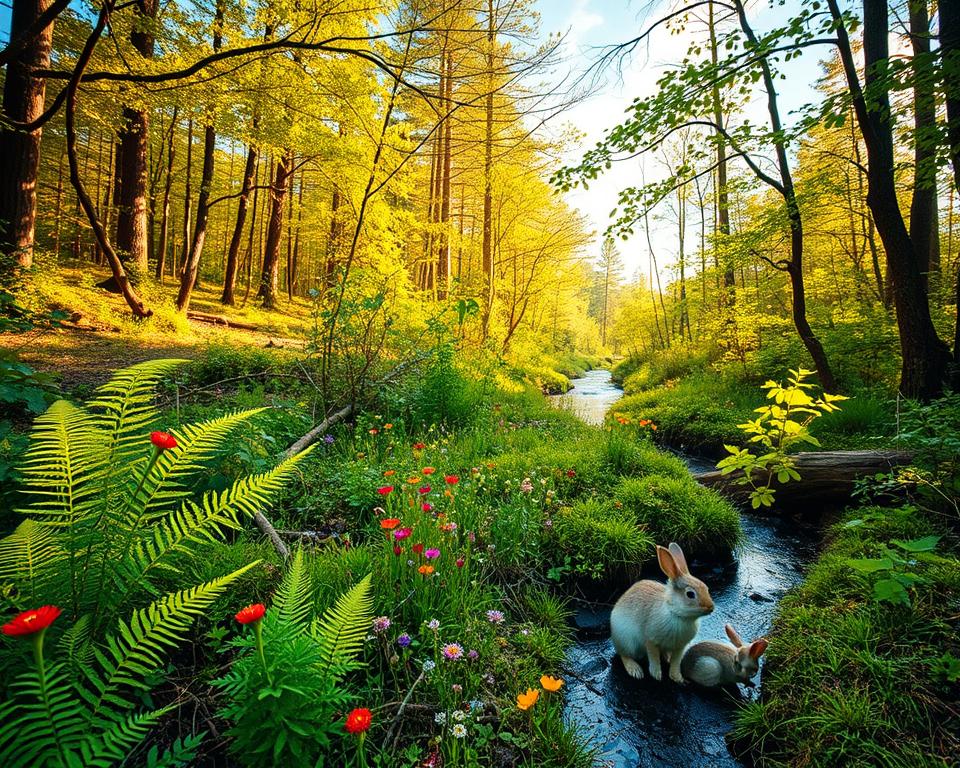
Researchers say yes. Small climate differences under canopies, along streams, or on shaded slopes create cool refuges that help plants and animals endure heat and drought. These local refuges are visible signs of how nature adapts as climate change reshapes regional conditions.
The article frames Mikroklimaty oferujące zaskakującą bioróżnorodność as a present-day signal for conservation. It shows why species richness often depends on fine-scale factors, not just broad temperature averages.
Readers will get a short trend analysis of what this pattern means now. The piece highlights three arenas—forests, mountains, and cities—and draws on field work in the Great Smoky Mountains and Mediterranean forests, plus applied examples like green roofs.
The goal is clear: deliver evidence-led insight and practical takeaways for land managers and planners who need actionable signals, not vague averages.
Anúncios
What “microclimate biodiversity” means in today’s climate change conversation
On the ground, a few degrees and added shade rewrite the rules for plant and animal survival. This section defines how local, ground-truth conditions shape species patterns and conservation choices in the present climate.
Microclimate vs. macroclimate: why measurement scale matters
Regional grids produce coarse dane such as mean temperature per square kilometer. Those macroscale values often sit above the canopy and miss what lives below.
Field badania uses sensors under the canopy, in stream corridors, and in leaf litter to capture real conditions. In the Smokies, below-canopy monitors show cooler, wetter pockets that macroscale records miss.
Anúncios
Small shifts, big ecological effects
Short-distance differences—north-facing slopes, damp coves, or wind-sheltered hollows—can raise local species richness and change community makeup.
- Local drivers: shade, soil moisture, and wind shelter.
- Dlaczego to ważne: averages hide peak-to-valley contrasts in complex terrain.
- Management use: identify refuges to buffer ecosystems from extreme heat and drought.
Trend snapshot: why microclimates are emerging as a top biodiversity signal right now
Policy alerts and new field work have made small-scale climate detail a top conservation signal. In 2021, IPCC and IPBES framed climate change and biodiversity loss as linked crises that need joint action. Carnicer-led studies reinforce this by showing local cool, wet pockets can shelter species when broad models predict large losses.
Research momentum linking crises and solutions
Growing research projects pair ground sensors with remote data to map refuges and risk zones. These studies show that extremes—heat waves and droughts—are the moments when most ecological impacts accelerate.
From nice-to-have to necessary: measurements reshaping forecasts
Models now layer topography, canopy structure, and water availability to create management-relevant scenarios. That shift helps planners see where ecosystems may hold up and where they face rapid change.
- Dlaczego to ważne: fine-scale maps bridge climate change and biodiversity planning.
- Practical shift: ongoing projects use sensors plus models to detect refuges that coarse products miss.
- Expectation: model outputs are treated as decision-support scenarios, not certainties, especially in rugged terrain.
Microclimates Offering Surprising Biodiversity in forests, mountains, and cities
Local climate pockets in woodlands, alpine bands, and built areas shape where life can hang on during intense heat and drought. These places do not stop climate change, but they shift where stress falls across the landscape.
Forest refuges in extreme heat
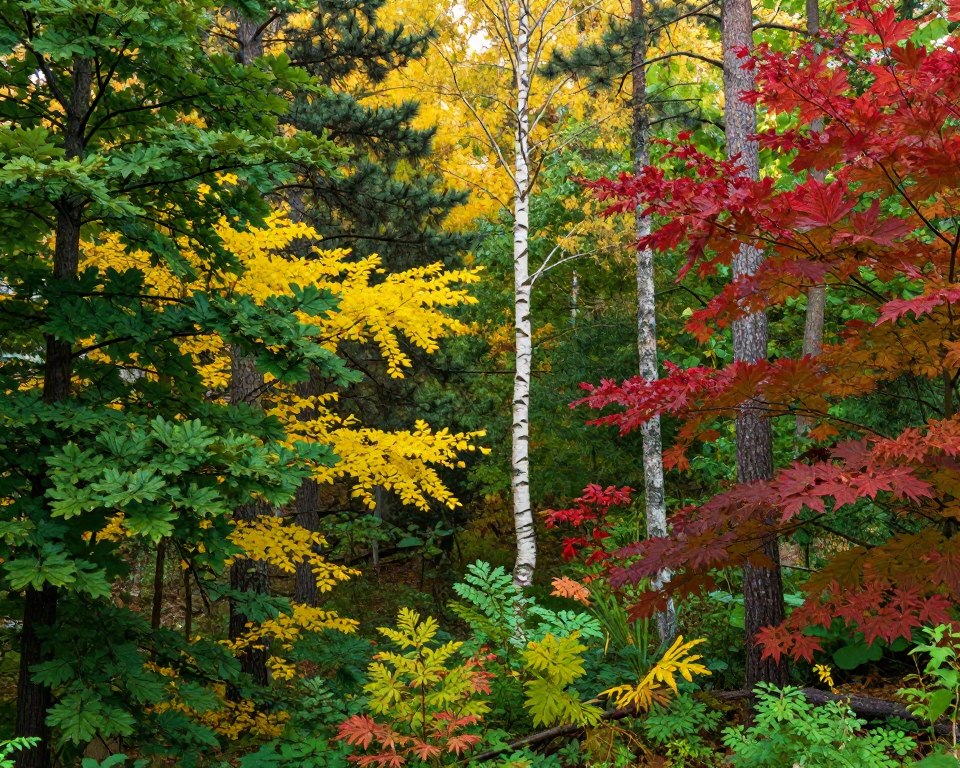
Dense canopy and layered vegetation keep the ground cooler and moister than open areas. That shading cuts evaporation, reduces daytime temperature swings, and saves seedlings and invertebrates when heat peaks.
Mountains as patchwork habitats
Slope, aspect, and elevation create adjacent pockets of different temperature and moisture. Species move across short distances to find suitable conditions, producing high turnover and local richness.
Green roofs as urban microclimate islands
Even thin soils on rooftops can host bees, hoverflies, and rare plants when designed with varied substrates and small water features. These “green islands” give refuge in otherwise hot, paved environments.
- Where it shows up: under canopy, along sheltered slopes, and on designed roofs.
- How it helps: moderates temperature and keeps soil moist during heat events.
- Limit: refuges redistribute risk; they do not eliminate it.
How researchers measure microclimates under real-world conditions
Field teams use a layered measurement approach to capture what life actually experiences beneath the canopy. Above-canopy towers record well-mixed atmospheric data while small sensors record the understory conditions that matter to organisms.
Below-canopy sensors vs. above-canopy instruments
Above-canopy instruments give broad context: wind, humidity, and regional temperature. Below the canopy, inexpensive loggers in PVC cases track the microclimate that seedlings, insects, and salamanders face.
Soil moisture and temperature as the “hidden variables”
Soil moisture and near-ground temperature govern dehydration risk, fungal outbreaks, and habitat suitability. Salamander biologists in the Smokies often prioritize soil probes for that reason.
Why low-cost tech still requires high-effort fieldwork
Micro sensors can be simple circuit boards powered by watch batteries. They still need hiking to install and retrieve, and regular checks over czas.
Data challenges in rugged ecosystems
Rugged terrain, sensor loss, and wildlife interference—bears chewing casings—add noise and gaps. That randomness makes dense sampling and careful study design essential; well-replicated datasets are therefore especially valuable for interpreting ecological effects.
Great Smoky Mountains case: a living laboratory for microclimate data
The Great Smoky Mountains serve as a working lab where steep slopes, fog, and dense forest make short distances feel like different worlds. This park offers a clear example of how topography and vegetation produce rapid shifts in local conditions.
Why species turnover can happen within a third of a mile
In the Smokies, a hike of roughly a third of a mile can move you from cove-hardwood to spruce-fir habitats. That change shows how quickly species and community composition respond to elevation and exposure.
How elevation and fog create “islands” of conditions inside one park
The park is nearly 95% forested and contains 45 watersheds. Fog and mist linked to vegetation and terrain form cool, wet islands that resemble far-northern ecosystems in pockets.
- Research example: R.H. Whittaker’s foundational work set the stage, and ongoing research by Jason Fridley (Department of Biological Sciences) and graduate Jordan Stark uses sensors to map these patterns.
- Dlaczego to ważne: watershed networks, vegetation, and slope are key factors shaping local ecosystem response to present climate change.
- Podsumowanie: the Smokies project offers usable examples for later sections on canopy buffering, salamander indicators, and improved models.
Forest canopy buffering: the “warm, wet blanket” effect shaping survival
Canopy structure governs the lived climate below the crown. It reduces wind mixing, traps thermal radiation close to the ground, and keeps soils shaded and moist.
How canopy structure dampens temperature swings in the understory
Layered leaves and branches act as a physical barrier. That barrier lowers daytime peaks and raises nighttime lows, so understory temperatures swing less than air above the canopy.
Why buffering strengthens on the hottest days and in the hottest climates
Buffering matters most when risk is highest. On extreme heat days, reduced wind and extra shade keep soils and seedlings from drying fast, improving short-term survival.
Transpiration and moisture recycling behind the Smokies’ iconic mist
Trees recycle water actively. About 95% of uptake returns to the air; a large oak may transpire ~40,000 gallons a year. That moisture helps form mist and aerosol droplets in places like the Smokies.
Cooling power of trees and what it implies for heat stress in ecosystems
One mature tree can produce daily cooling similar to two home air conditioners. That cooling lowers stress on plants and animals, backing up the role of vegetation in stabilizing local ekosystemy.
- Key process: reduced wind, trapped radiation, shaded soils.
- When it matters most: hottest days and warmest regions.
- Uncertainty: canopy loss and longer droughts may weaken these local buffers over time.
Microclimates and salamanders: why bioindicator species sharpen the trendline
Salamanders live—or die—on the fine balance of moisture and cool air right at ground level. Their fortunes offer a clear, local signal about changing microclimate conditions and broader forest health.
Why some salamanders are uniquely sensitive
Roughly 760 salamander species exist worldwide, and about one-third occur in North America. Many adults are lungless and breathe through delicate skin. That makes dehydration and small temperature shifts immediate threats to survival.
Southern Appalachia as a hotspot
Southern Appalachia hosts about 78 species, with 31 in the Great Smoky Mountains. This concentration gives scientists strong local badania power to link organism responses to tiny climate gradients.
Cryptic refugia and limits to movement
Cryptic refugia are hidden pockets where gatunek persist despite surrounding warming. High-elevation creatures may face mountaintop islands and cannot move upslope, so these refugia matter for long-term survival.
- Why salamanders matter: their skin makes them early warning organisms for moisture loss.
- What monitoring shows: local shifts in temperature and humidity often precede wider ecosystem effects.
- Management note: protecting cool, damp areas in key areas helps maintain species and overall bioróżnorodność.
Species distribution models are getting a microclimate upgrade
Species distribution models gain precision when researchers add fine-scale temperature and soil moisture records to broader climate layers. Fridley and Stark use ground sensors to feed microscale inputs into predictive tools.
How microscale climate models improve predictions in valleys, ridges, and streams
Valleys, ridges, and stream corridors can show very different conditions inside a single grid cell. Adding sensor-based dane reveals these contrasts and changes where species are likely to persist.
What stability at mid-elevations suggests about future composition shifts
Fridley and Stark find higher stability for mid-elevation species, especially near streams buffered from heat. That pattern points to refuges where community reassembly may be slower.
Why models show scenarios, not certainties, in the present context
Models explore alternative scenarios based on inputs and assumptions. They map plausible futures over czas, not a single forecast.
- Practical gain: upgraded models guide monitoring placement and conservation now.
- Management note: prioritize streamside mid-elevations as likely refuges.
- Honest limit: outputs are decision tools, not exact predictions.
Mediterranean research signals: microclimates as resilience engines, not uniform outcomes
Recent research from southern Europe finds that small terrain differences shape which areas resist heat and drought. Carnicer-led studies show that treating a landscape as uniform can exaggerate predicted losses under current climate change scenarios.
Why homogeneous-territory scenarios can overstate disruption
Models that assume even conditions miss sheltered pockets that stay cooler and wetter. Those pockets damp local impacts and keep species alive while nearby spots decline.
How orientation, altitude, and soil thickness modulate outcomes
Topography matters. North-facing slopes and valleys often hold moisture and lower daytime heat. Ridges with thin soil heat faster and show summer decay.
- Key topographic controls: orientation, altitude, and soil depth.
- Contrast in areas: valleys and north slopes = persistent refuges; exposed ridges = higher dieback risk.
- Broader takeaway: regional studies repeat this pattern, so microclimates act as engines of local resilience across different ekosystemy.
These findings push trend analysis toward finer mapping. Adding terrain, soil, and orientation into assessments produces more credible impact estimates and better guides on-the-ground conservation.
Insects in the data: butterflies as measurable indicators of thermal stress
Insects record the climate at ground level; butterflies especially flag rising thermal pressure. Long-term monitoring and targeted lab work turn count records into clear ecological dane that managers can use.
What long-term drought trends reveal about population declines
A notable badanie by Carnicer, Stefanescu, and Vives-Ingla (2019) links decades of drought and a lack of canopy refuges to steady butterfly losses in Mediterranean open habitats. Counts across ~30 years show exposed sites decline faster than sheltered ones.
How canopy refuges buffer temperatures
Under beech canopy refuges, local temperatures can be about 5°C lower than ambient. That cooling preserves host plants and improves larval survival during heat spells, reducing negative effects on population growth.
Phenotypic biomarkers and lab replication
Field dane reveal reduced body size and shorter wings as summer heat intensifies. Laboratory replication helped isolate climate impacts from other factors, clarifying the proces behind morphological change.
The takeaway: insects serve as precise, measurable sentinels. Linking field counts, experimental dane, and temperature records strengthens conservation choices that protect cool refuges and broader food webs.
Topography creates winners and losers within the same forest ecosystem
Topographic detail—folds, hollows, and ridgelines—creates a patchwork of ecological risk and safety. Within a single forest, those shapes set local conditions that determine which species persist today.
Valleys and north-facing slopes as persistent climatic refuges
Valleys and shaded, north-facing areas hold cooler air and retain moisture longer. That extra shade and pooled coolness protect seedlings, soil microbes, and moisture-sensitive animals during dry spells.
Ridges with thinner, barer soil as hotspots for summer dieback risk
Ridges heat faster. Thin, bare soil warms and dries quickly, so plants there face greater impacts from summer heat and drought. Dieback shows up first where soil depth is lowest.
- Planning lens: one forest contains both refuges and hotspots—use topography to target actions.
- Why refuges persist: shade, cool-air pooling, and deeper soil keep moisture and stable conditions.
- Why ridges fail: thin soil, exposure, and high solar load amplify stress and increase mortality.
- Species response: different plants and animals win or lose within the same ecosystem, so averages hide the true contrast.
- Następny krok: this pattern foreshadows urban parallels where design and small slopes make local areas very different.
Urban microclimates: green roofs as unexpected biodiversity refuges
Simple design choices on a roof—logs, sand, and a shallow water pit—turn a bare surface into useful habitat for many organisms. Green roofs act as small green islands that cool the immediate area and offer food and nesting sites in hot urban areas.
How “green islands” support bees, hoverflies, and rare plants
Well-designed roofs host bees, hoverflies, and even rare orchids when they provide sun-basking spots, nesting substrate, and varied vegetation. These species use rooftops as feeding stops and temporary refuges as the city gets hotter.
Designing microhabitats with logs, sand banks, and small wet features
Adding log piles, sand banks, and a simple “hoverfly lagoon” (a bucket with logs and leaf slurry) boosts nesting and larval sites. Bee banks and bee hotels increase cavity-nesting species on small rooftop projects.
Why open mosaic habitat can outperform “pretty” plantings
Brown or biodiverse roofs that include bare ground and low-nutrient substrate often support more invertebrate diversity than manicured beds. In practice, open mosaic habitat creates multiple niches and stepping-stone areas across the city, helping organisms persist and move in the present climate.
Connectivity trend: stitching microclimates into networks for ecosystem resilience
Cities and suburbs are beginning to link small cool patches into working corridors that wildlife can actually use. This trend treats many small sites as a single system, not isolated spots.
Stepping-stone habitats across fragmented urban and suburban landscapes
Stepping-stone planning places green roofs, parks, gardens, cemeteries, allotments, and road verges so species find repeated stops for food, shelter, and breeding.
These linked spots reduce fragmentation effects and help movement, recolonization, and seasonal shifts for common and sensitive species alike.
Where parks, gardens, road verges, and rooftops fit into biodiversity planning
Practical wins often come from coordinating existing areas rather than creating large new reserves. Planners map cooler, moister niches and then connect them with corridors and small habitat patches.
- Complementary pieces: rooftops, verges, and small planters act with parks to form networks.
- Varied niches: networks work best when they include a mix of temperature and moisture conditions.
- Management focus: simple projects scale—many small sites add up to real resilience.
For applied guidance and recent evidence, see recent research on connectivity.
What’s at stake in the present: water, forests, and cascading ecosystem services
Healthy forests act like living pumps, moving water from soil to sky and shaping local humidity. That daily exchange supports streams, keeps air moist, and helps form the Smokies’ signature fog.
Why forest health links fresh water on the ground to water in the air
Trees draw groundwater and release most of it back as vapor. In the Smokies, individual trees can return about 95% of uptake to the atmosphere through transpiration.
This process keeps local humidity higher, cools the understory, and sustains stream flow during dry spells. Protecting these functions preserves more than species — it preserves water cycling and temperature regulation that people depend on.
How heat waves, drought cycles, and late frosts can stress trees over time
Warmer early springs can trigger early leaf-out. A late frost in May can then kill new growth and stunt a tree for the season.
Repeated heat waves and alternating heavy rains and droughts weaken growth rings and reduce vigor. Over time, forests lose their buffering power and the local climate effects that many organisms rely on change too.
- Dlaczego to ważne: weakened trees mean less moisture return, lower stream baseflow, and warmer local air.
- Human stakes: watersheds, drinking supplies, and flood regulation all depend on intact forest processes.
- Trend lens: protecting fine-scale refuges and canopy function is now core climate change adaptation, not just a niche conservation task.
How land managers can use microclimate data now
Land managers can turn small-scale climate records into clear, actionable steps today. Short-term dane from below-canopy sensors and soil probes tells which areas actually stay cool or moist during heat and drought.
Where to prioritize monitoring
Start with streams, north-facing slopes, and dense canopy zones. These areas repeatedly show buffered conditions in rugged parks and urban green networks.
Design conservation around refugia, not averages
Use field dane to map refugia that remain cooler or wetter. Protecting those pockets provides higher near-term returns than protecting sites chosen by regional averages alone.
Pair field work with models and scenarios
Combine sensor records with modele to rank priority sites for protection, restoration, and connectivity. Treat outputs as management scenarios to test options, not as fixed forecasts.
- Krok praktyczny: place loggers near streams and under closed canopy.
- Restoration focus: rebuild canopy, add riparian shade, and increase soil moisture retention.
- Integration path: fold microclimate layers into park plans, adaptation projects, and urban programs.
Wniosek
mocny, Fine-grain climate signals are proving to be the most useful guide for where species will persist today. Field work shows canopy refuges can be about 5°C cooler and that simple rooftop mosaics support diverse invertebrates in hot cities.
Across forests, mountains, and towns, local pockets act as refuges during heat and drought. Those same pockets create uneven outcomes—persistence in some spots and loss in others.
Better measurement of below-canopy temperature and soil moisture, paired with improved models, yields finer, more realistic scenarios for planners. Protecting and reconnecting these places—from stream corridors and north slopes to green roofs—builds practical resilience.
Present-focused takeaway: treat microclimate features as actionable infrastructure that sustains species and ecosystem services as climate change intensifies.